
"We're doing it by shifting an industry from manual workflows to AI-driven operations"
Our partner, Mikkel Weikop, was interviewed by Orazio Branca in EmobiliTea Talks on the role of data and AI in EV charging operations.
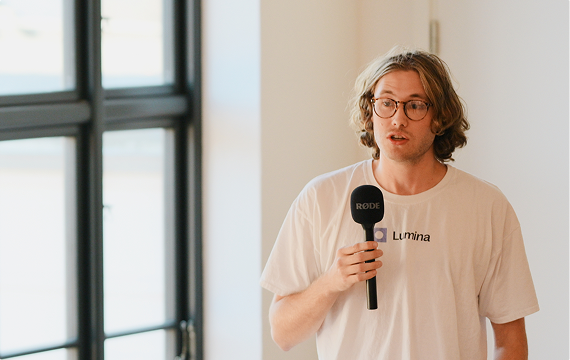
Below is the full interview from EmobiliTea Talks — questions and answers unchanged.
When you look ahead 5–10 years, how do you envision the role of data-driven platforms like Lumina AI in shaping a reliable, scalable EV charging infrastructure across Europe?
In 10 years, I believe solutions developed by companies like Lumina, and many others, will form a core foundation of global EV charging infrastructure. Today, data and algorithms already shape critical systems around us. They map the fastest route home on our GPS, power grids balance load automatically across regions, payment networks detect fraud in milliseconds. Looking at these industries, it becomes clear that data and algorithms will play the same role in EV charging, and in many ways, they already do. The key question is when and how companies choose to use their data. Early adopters will gain a significant head start, but the window of opportunity is still in its early stages, and we will see many data-driven solutions introduced in the years to come. In this context, our ambition is to be at the forefront of autonomous EV charging operations.
What do you consider the biggest unsolved challenge today in EV charging networks — and how can intelligent monitoring help solve it?
The most important is probably a connected global network that allows anyone, with any car, to charge easily wherever they want. Right now, it's a mess, with different apps, outlets, output qualifications, payment methods, UX and design. However, this is not something intelligent monitoring will solve. Within our vertical, it will be to prevent drivers from having bad experiences, first and foremost. Before a state of errorless stations and frictionless charging, there's an important step in securing experienced reliability for the driver. That includes faster- and better maintenance, driven by automation and proactive measures. We believe that it's possible to secure the user experience — even before a perfect performing network — by pursuing proactive care and limiting potential liability.
From your view, what would be the next extremely ambitious goal for Lumina on the broader energy transition and e-mobility adoption?
We're building the Agentic Operations. This is our current ambitious goal. We're doing it by shifting an industry from manual-heavy to AI-driven operations. As for the next, I cannot say with certainty, as we try by rule to keep a strict focus on current development, but without saying too much, what we're building right now, has an interesting potential, as it will be data agnostic.
AI is rapidly becoming a differentiator in the EV charging ecosystem. From your perspective, how can AI truly become a game changer in enabling fast, reliable predictive maintenance. What concrete improvements can operators expect when moving from reactive to intelligent, data-driven maintenance models?
The first improvement than an operator would observe is efficiency. Intelligent detection and handling, enable a self-driving system that greatly improves how the operations team reacts and handles every single case. We periodically pull data to quantify the impact of newly pushed features, and in a recent review, we were excited to see that some of our operations teams have reached a 4x in operational output per employee.
Looking ahead, how do you see operations and maintenance evolving in the EV charging ecosystem? Do you envision a future — and how far away might it be — where maintenance becomes fully autonomous through machine-to-machine interaction, with chargers continuously communicating component-level health data, backends executing monitoring and instant remote troubleshooting, and even automated spare-part orders being triggered by predictive models?
On a data level, a fully autonomous system is not a distant future, and the mentioned cases are for the most part, already realities. Some chargers automatically signal when to order spare-parts, although usually based on usage, not predictions. The autonomous system developed by Lumina can already handle over 70% cases fully autonomously, with the remaining being assisted end-to-end by AI. This ratio will likely increase in favor of the autonomous, and will enable operators to grow their business with tens of thousands of chargers, without having to scale headcount linearly. The vision remains to let small teams orchestrate operations strategically while our AI manages the daily work.
Could you walk us through a concrete case where your machine-learning models identified an invisible issue, and how that helped the operator improve their service?
Yes. I'll give you a very specific example. When our models monitor a consistent cap in average effect over time on a charger relative to its location, in the majority of cases it's the result of a broken power module, which our models then verify by looking at some other parameters automatically. Basically, what this means, is that the charger charges, but sub optimally, reducing the max kWh output by 25-75%. Detecting this allows the operator to deliver the promised kWh output to the drivers, greatly affecting user experience.
As a founder and partner at a young startup, how do you nurture innovation and a data-first mindset within the team?
We believe in- and try to live by the importance of building features that provide instant value to our operators. In practical terms this means, that every time we discuss our roadmap, modifications or new product features, we ask — not ourselves — but our operators, if this new feature would be of instant value to them.
Have there been moments of uncertainty or failure, and what lessons emerged that shaped Lumina's roadmap or vision?
There have been lots. I'll give you two defining ones. When we started, we'd supply the operations team all of our insights and processed data. This led to an overwhelming amount of information, that was impossible to utilize efficiently. So, we essentially went from exposing all of the processed data, to carefully curating what to see, and when to see it. Consolidation and curation became the first big lesson, after a moment of uncertainty, due to our initial output being unusable. The second — an in my opinion most defining — pivot, was when we changed our focus away from predictions. Predictions are nice, but it requires an optimal current state of affairs to be valuable. Because who cares if you can predict a fault seven days in advance, if you're barely catching half of the current issues at hand. And that was the reality. So instead of subscribing to a distant potential, we decided to fix today, which led us to where our product is today; creating Agentic Operations that provides much more value for the operator. It is interesting to mention, that when we made this decision, we had already built the models, and the predictions provided by them were our entire value proposition. Fortunately, constraints often allows one to see things clearer.
In your opinion, how important are operators and CPOs using data-driven tools to win user trust and scale adoption?
Well, if we just take the Operations & Maintenance category as an example. Through our agentic infrastructure operations teams work smarter and faster. As mentioned earlier, we've seen up to 4x operational output per employee in some cases. While this in itself doesn't directly impact the driver, a derived effect of our solution is the reduced time to resolution, through optimized handling. So, the time from the issue is detected, to the point of successful resolution. So far, we've seen reductions in the Time to Resolution by up to 80%, by utilizing autonomous detection and handling of cases. That is felt by the end-user, because it directly increases the operational uptime of the network. It acts before small issues become problems for the drivers. It can almost eliminate the time from alert to initiated resolution, where users can risk using a faulty or ineffective charger. All in all, the driver will experience better networks. And then there's all the other data-driven tools that our industry colleagues in other inspiring companies are developing, all of which contribute to winning user trust for an electrified transportation sector.
Do you foresee a role for standardized data/analytics AI platforms across different countries and operators or will this ecosystem remain fragmented?
In Lumina, we are looking to become the standardized AI operations and maintenance platform for operators globally. So, this is definitely something that I foresee, and hope to see realized. We started in 2024 in Denmark, with Spirii. In 2025 we expanded our solution to partners in 6 new countries. In 2026, we seek to continue this momentum, which we are very excited about.
What motivated you personally to make a jump of paradigma, moving from Graphic Design, Media to now focus your career on EV charging, and to build Lumina from the ground up?
There have been multiple motivating parameters for me. First of all, it is very much in my DNA, having two parents who've both successfully started and built companies, which has been an inspiration throughout my entire childhood and career. Luckily, they still help guide many of my decisions. My personal little advisory board, you could almost say. And then it was the team, my partners. I was fortunate to be introduced to- and then get to work with three incredibly talented and clever people, which is a motivational factor on a daily basis in itself. Together, we're driven by building a product that's not just good, but the absolute best on the market. In regard to the directional change, it's actually funny, because in many ways it can feel as though I'm still within my initial space, in my day-to-day work. For example, my responsibilities in Lumina include the design and development of our platform, which is a combination of data visualization, UI, UX and front-end development. In addition, a big part of my studies revolved around the creative part of the process - the phases before and up to the actual execution - which I get to draw on often, as we are constantly iterating and evolving our product. Lastly, the marketing aspects of Lumina - which has been my industry for the previous 7 years - also involve quite a bit of design and creative thinking, both in terms of the visuals, but also in areas like copy, identity and tone of voice. The only paradigm change has been in industry, which I can only appreciate, because I am now working in an industry that works FOR a sustainable transition. Not as a buzz word or a coincidental feature, but as a core part of the industry. So, fortunately, there's no lack of motivation.
If you could give one piece of advice to an entrepreneur entering the e-mobility or energytech space today, what would it be?
It's a small thing, and not exclusive to e-mobility or energy tech. But taking notes. When building a company from scratch, everything moves incredibly fast. You'll experience crazy amounts of wins and losses. If you wanted — and had the time — you'd have reasons for celebration, and of frustration, every day. You'll talk to hundreds of people, have meetings constantly. Features will be shipped on a daily basis. Requests will come pouring in. All of this is fun and exhilarating, but it also means that much of it will be remembered in consolidated blurs. It's simply impossible to remember everything. For me personally, my notes are essential. I don't write detailed, well-structured records, but I jot down names, summarize meetings, log requests, underline key ideas, all of which I can then use to great extent, when scheduling my days, prepare for meetings or prioritizing work. And it also functions as a kind of minimal viable diary.
Outside of work, is there a mindset, habit or routine that helps you stay creative and grounded, especially when dealing with complex challenges?
I was taught by my professor, Karsten Vestergaard, 4 years ago, to be an Everlearner, and although I admittedly have always thought the expression itself to sound kind of cheesy, it has been an important part of my mindset throughout my studies and work since. At its core, it's the recognition that no matter how skilled you become or how much you know about a subject, the field will continue to evolve. There is always more to learn, and staying competent means staying curious. In that sense, it's a practical extension of the classic idea that the more you know, the more you realize you don't know. You have to make it a part of your general mindset, to actively keep on learning. Something woven into your routines and, ultimately, your way of working and living. What that looks like differs from person to person. For me, it largely comes down to reading books. Sometimes about subjects I know well, sometimes subjects I know very little of, and sometimes subjects I wouldn't have thought myself to be interested in at all. It seems that every piece of new or re-learned knowledge can always be put to use in one way or another.